


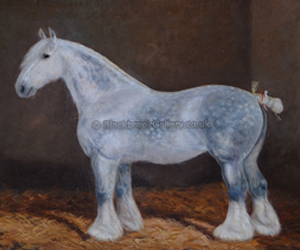
Featured Artist: Albert Clark
Albert Clark (1843 – 1892) was a London-born artist who built a distinguished career as one of the most prolific animal painters of the late Victorian era. Best remembered today for his depictions of horses, cattle, and prize livestock, Clark followed in the footsteps of his father, James Clark, himself an accomplished animal painter whose work ‘The Runaway Horse’ was dedicated to his second son, Albert. The younger Clark was first recorded as an artist in 1861, at just 17 years of age, and went on to produce a remarkably varied body of work over more than three decades.
Style and Technique
Clark’s paintings are firmly rooted in the British naive animal tradition, balancing careful observation with the warmth and charm that has kept Victorian livestock art in demand today. His work is characterised by:
- A particular gift for equine portraiture, with horses depicted in confident, anatomically sound poses that capture both breed and individual personality.
- Detailed rendering of coats, manes, harness, and stable fittings, reflecting his hands-on familiarity with working horses.
- A range of subjects spanning racehorses, Shire horses, prize cattle, sheep, and even pigs, showing his versatility as an animal painter.
- Pastoral landscape backgrounds and atmospheric stable interiors, often used to frame the subject without distracting from it.
- A warm, naturalistic palette suited to the English countryside, with rich blacks and browns in his Shire portraits especially.
- Occasional inclusion of figures such as jockeys, grooms, or handlers, adding narrative interest to commissioned works.
His paintings carry the assurance of an artist who knew his subjects intimately, having grown up in an animal painter’s studio and spent decades observing horses and livestock at first hand.
Career and Commissions
Although Clark painted cattle and dogs, his speciality was the horse. He was regularly commissioned to produce racehorse portraits throughout his career, with patrons occasionally requesting that the jockey also appear in the picture. As a Londoner living close to the Islington Agricultural Hall, Clark was also fortunate to secure the prestigious commission of painting portraits for the Islington Horse Show prize winners, a role that placed him at the centre of one of the most important equine events of the Victorian calendar.
Forty years into his career, at the age of 57, Clark was reported to have become deaf. Remarkably, he continued to paint for many years afterwards with no hearing, never abandoning the craft to which he had devoted his working life. Though his very last work is still debated, an article reporting on the Islington Summer Horse Show in May 1892 mentions a prize winner “having his portrait taken by a London Artist”. Given Clark’s long association with the event, it is widely thought that this sketch may have been his final piece.
Notable Works
Examples of Albert Clark’s paintings available at Blackbrook Gallery include:
- Saucy Boy. One of Clark’s best known works, a characterful named horse portrait.
- Shire in a Country Landscape. A fine pastoral piece showing his skill with the heavy horse in open country.
- Champion Shire. A prize Shire portrait capturing the breed’s power and stature.
- Black Shire. A striking single Shire study with rich tonal depth.
- Shire Horse in a Stable. An atmospheric interior showing Clark’s feel for working environments.
- Prize Shorthorn Heifer. A reminder that Clark’s talents extended well beyond horses.
- Middlewhite Pig in a Sty. A charming example of his rarer pig portraits.
- Highland Steer. A handsome study of one of Britain’s most distinctive cattle breeds.

Why Collect Albert Clark
Albert Clark’s paintings remain highly collectable for their craftsmanship, their breadth of subject, and their direct connection to Victorian horse culture. His Shire portraits in particular celebrate a breed that defined English working life for centuries, while his racehorse commissions offer a glimpse into the high society of nineteenth century equestrian sport. The variety of his output, taking in everything from prize cattle and pigs to Highland steers and stable interiors, means there is an Albert Clark painting to suit almost every collector of agricultural and sporting art.
At Blackbrook Gallery, Clark’s paintings are valued not only for their visual appeal but also for their story, the work of an artist who painted from boyhood until his final years and who chronicled the working animals of Victorian Britain with affection and skill. They sit beautifully in country house settings, equestrian collections, and traditional farmhouse interiors.
These works reflect a rural tradition that has influenced generations of breeders and collectors alike. Explore our collection here and discover more about our cattle breeding here.