


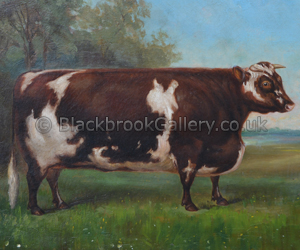
Featured Artist: A. M. Gauci
A. M. Gauci (op. 1848 – 1880s) was a London-based animal painter and engraver best known for his portraits of pedigree cattle, particularly Shorthorns and Herefords. Born into a family of established London lithographers, with both his father and brother working in the trade, Gauci was immersed in the world of printmaking from an early age. This dual background as painter and engraver gave his work a precision and clarity that made him a natural choice to illustrate some of the most important livestock records of the Victorian period. Though less widely known today than contemporaries such as Thomas Weaver or William Henry Davis, Gauci occupies a quietly important place in the history of British animal art.
Style and Technique
Gauci’s paintings sit firmly within the 19th century British tradition of naive animal portraiture, with a documentary quality that reflects his engraving background. His work is characterised by:
- A focus on pedigree cattle, especially Shorthorns and Herefords, depicted in full profile to showcase breed character.
- Careful anatomical detail, with prize bulls and heifers rendered to emphasise the qualities valued by Victorian breeders, from broad backs to deep flanks.
- Soft, naturalistic landscape backgrounds featuring rolling pasture, distant trees, and gentle English skies.
- A warm, earthy palette of russet browns, creams, and muted greens that flatters the subjects without overwhelming them.
- A clean, balanced composition typical of an artist trained to translate his work into print.
- Frequent inclusion of the animal’s name, owner, or breeding details, reflecting his role as both portraitist and record-keeper.
The combination of painterly warmth and engraver’s discipline gives Gauci’s work a quiet authority that has kept it sought after by collectors of agricultural art. Where some Victorian livestock painters leaned toward flattery and exaggeration, Gauci’s training in lithography encouraged a more measured, observational approach.
Notable Works and Contributions
Beyond his easel paintings, Gauci made a significant contribution to livestock record-keeping. He engraved many of the Shorthorn illustrations published in the Coates Herd Book between 1863 and 1867, a foundational document of British pedigree cattle breeding, first established by George Coates in 1822 as the very first herd book of its kind in the world. Through this work, Gauci’s engravings became part of the official visual record of the breed, viewed and referenced by generations of breeders. He also contributed a plate to A Comparative View of the English Racer and Saddle Horse (1836) and engraved The Age, after the celebrated coaching scene by C. C. Henderson.
Examples of A. M. Gauci’s paintings available at Blackbrook Gallery include:
- Forget me-not Shorthorn Heifer. A graceful named portrait of a pedigree heifer, showing Gauci’s eye for breed character.
- Hereford Heifer. A fine example of his Hereford work, with the breed’s distinctive white face beautifully rendered.
- Archibald Hereford Bull. A stately bull portrait celebrating one of Victorian England’s most prized breeds.
- Earl of Derby. A named pedigree portrait that demonstrates Gauci’s skill in capturing both anatomy and individual character.
- Shorthorn Bull. A classic example of Gauci’s contribution to Shorthorn portraiture, the breed for which he is most celebrated.
- Shorthorn Heifer in a Landscape. A signed work pairing a pedigree heifer with a softly painted English pastoral setting.

Why Collect A. M. Gauci
Gauci’s paintings appeal to collectors for their craftsmanship, their historical importance, and their direct link to one of the most significant chapters in British agricultural history. His involvement with the Coates Herd Book places him at the heart of the Victorian pedigree movement, and his named cattle portraits offer a tangible record of the prize beasts that shaped modern breeding. For collectors with an interest in Shorthorn or Hereford bloodlines, his work carries an extra layer of resonance, as these are not generic animals but identifiable individuals whose descendants can often still be traced.
At Blackbrook Gallery, A. M. Gauci’s paintings are appreciated not only for their visual charm but also for the way they document a moment when British livestock breeding reached its artistic peak, with every named heifer and bull representing a small piece of agricultural heritage. They make particularly fitting additions to country house interiors, farmhouse kitchens, and any collection where rural tradition is celebrated.
These works reflect a rural tradition that has influenced generations of breeders and collectors alike. Explore our collection here and discover more about our cattle breeding here.